

The prospect of amplifying returns with leverage is surely appealing in forex and CFD markets. But while it is one of the most powerful tools in a trader’s arsenal, it is also the easiest way to crash if misused.
Leverage allows traders to control positions much larger than the funds in their account would otherwise allow. From 1:30 to 1:3000 or even up to 1:10000, how much leverage do traders actually need? What do these numbers mean in everyday trading?
Data show that leverage limits reduce average losses by 40%. Therefore, understanding how leverage works, how regulators set limits, and how to use it responsibly is essential for anyone interested in a long-term approach in trading.
Here we will be looking at:
- Definition and range of leverage
- Risks and rewards of leveraged trading
- The concept of effective leverage
What is leverage
Definition
Leverage means using borrowed money to increase trading position size. If a broker offers 1:100 on GBP/USD, then a $100 deposit allows the trader to control a $10,000 position, as only about 1% of the value is required as margin.
In forex markets, brokers offer a whole range of leverage depending on the asset and the jurisdiction. This lets traders gain exposure to larger market moves while committing a fraction of the full trade value. In theory, this means bigger opportunities, but it also means that small market moves can have outsized effects on the account.
Asset classes
Leverage ratios differ substantially across asset classes, reflecting the unique risk profiles, volatility and regulatory restrictions associated with each market.
Forex trading typically offers the highest leverage, with major currency pairs often starting from 30 in stricter jurisdictions, thanks to their high liquidity and relatively stable volatility. While non-major pairs and exotics are generally restricted to 1:20 or lower because of greater price swings.
Commodities come next, with instruments like gold sometimes offered at 1:20, while more volatile assets such as crude oil and silver typically see it capped at 1:10. Stock indices, like the FTSE 100 or Dow Jones, may be available at up to 1:20, but minor indices and single stocks are usually limited further, often to around 1:5 or 1:10 due to the higher risks involved in individual equities.
Cryptocurrencies stand out for their extremely high volatility, so leverage is usually sharply restricted, starting from 1:2 in regulated markets
These distinctions help balance trader opportunity with prudent risk controls, making it vital for traders to understand the leverage available and the inherent risks.
Why use leverage in trading
Leverage is primarily used to magnify one’s market exposure, and that opens up a whole new world for retail traders.
Market access
Leverage gives access to markets previously reserved for well-funded players. Nowadays, individuals with modest sums can participate in currencies, indices and commodities. Moreover, leverage opens the door to larger markets that may otherwise be inaccessible. A trader with $200 cannot buy 0.002 lot ($200) worth of USD/JPY as minimum positions are 0.01 lot. but thanks to 1:100 they can now trade 0.2 lot ($20,000).
Profit amplification
A small positive move can translate into a large gain. This helps maximise opportunities, especially for day traders who seek small price changes. Suppose a trader has $10 and is offered 1:1000 leverage, they can control a position worth $10,000. If the chosen asset increases in value by 5%, the position grows to $10,500, realising a $500 profit, which is a 500% return on their initial capital. Without leverage, that same 5% market move would yield only a mere $0.5 profit.
Capital allocation
Traders can put their funds across multiple opportunities rather than tie up the whole account in a single trade. Leverage also allows for enhanced capital efficiency. By using borrowed capital, traders can keep a smaller cash balance dedicated to each trade and deploy their resources across different markets simultaneously. For example, with $5,000 on account and 20 leverage, a trader can diversify positions by allocating $1,000 of margin to five different trades, gaining exposure to currencies, indices, and commodities all at once. This approach helps maximise opportunity without over-concentration.
Here’s a hidden reason why forex brokers offer high leverage.
What are the rewards and risks
Rewards
High leverage means controlling substantial positions with minimal capital. A small positive move in the underlying instrument can produce outsized gains relative to the amount put down. For disciplined, experienced traders, this creates opportunities for tremendous returns, especially in fast-moving markets or when scaling positions.
Risks
But leverage is a double-edged sword. A modest adverse move quickly leads to margin calls or forced liquidation. For instance, a 1% loss on a position using 1:100 leverage wipes out the trader’s margin entirely, and with 1:3000, the buffer is thinner still.
The risk of losing all capital in minutes is extremely high, especially if traders use maximum position sizes, neglect stop-losses, or trade through volatile periods. Sudden gaps, news shocks, or illiquid markets can even lead to negative balances unless the broker offers protection, which many offshore firms do not.
- Amplified losses: Just as gains multiply, so do losses. Catastrophic account wipe-outs are common among traders who use excessively high leverage.
- Margin calls: If equity drops below margin requirements, brokers will close positions at a loss. Many traders underestimate just how quickly leverage can erode an account.
- Psychological hit: The stress of volatile P&L swings is exacerbated by leverage, leading to poor decision-making and panic trading.
See 8 offshore brokers with negative balance protection.
How much leverage can traders get
What are regulatory limits
Regulatory limits on leverage vary widely across the globe, but major regions like the UK, EU, Australia and Japan impose strict caps to protect retail folks. Offshore brokers, however, operate with far fewer restrictions, offering leverage up to 1:10000.
What’s the difference between onshore and offshore brokers
Leverage offerings may differ greatly depending on a broker’s regulation.
Onshore brokers
- United Kingdom (FCA): Retail clients are capped at 1:30 for major forex pairs, 1:20 for minors and gold, 1:10 for commodities, 1:5 for stocks and 1:2 for cryptocurrencies. Professional traders can apply for higher limits if they meet strict criteria.
- European Union (ESMA): Nearly identical to the UK with additional protections such as negative balance protection and strict risk warnings.
- Australia (ASIC): Formerly offered as high as 1:500 for retail traders, now reduced to 1:30 for majors, 1:20 for minors/gold/index CFDs, and lower for other assets. Professional traders may access leverage from 1:200 up to 1:500 if they meet eligibility.
- Japan (FSA): Among the most conservative, capping forex leverage at just 1:10 for retail traders.
- Asia/Other Regions: Varies by country, with some regulators like Singapore and Hong Kong capping leverage for major pairs at 1:20–30.
Offshore brokers
Offshore brokers, often regulated in places like Saint Lucia, Seychelles or Vanuatu, are not covered by UK/EU retail protections and thus routinely offer leverage of 1:1000, 1:2000, or even more.
These firms cater to traders seeking the most extreme exposure, but often lack negative balance protection, robust client safeguards or reliable dispute resolution. Carefully review offshore broker reputations and always favour transparency and clarity.
| Region / Regulator | Retail leverage limits | Professional leverage limits |
|---|---|---|
| United Kingdom (FCA) | 1:30 (majors), 1:20 (minors/gold), 1:10 (commodities), 1:5 (stocks), 1:2 (crypto) | Higher possible if strict criteria met |
| European Union (ESMA) | 1:30 (majors), 1:20 (minors/gold), 1:10 (commodities), 1:5 (shares), 1:2 (crypto) | Higher for professionals meeting criteria |
| Australia (ASIC) | 1:30 (majors), 1:20 (minors/gold/index CFDs), lower for other assets | 1:200–1:500 if eligible |
| Japan (FSA) | 1:10 (lowest retail forex leverage) | N/A |
| Asia / Other Regions | Singapore & Hong Kong: 1:20–1:30 (majors) | Varies widely |
| Offshore hubs (Seychelles, Vanuatu) | Over 1:1000+ (highest retail leverage) | Varies (often very high) |
For more details, see Onshore vs. offshore regulation: which is best for you.
How to choose the right leverage
Choosing the right leverage should be based on personal factors and the broker’s offerings.
Which personal factors to consider
There is no ‘one size fits all’ answer and the right amount of leverage depends on several personal and strategic factors:
- Trading experience: New traders should stick to the lowest available leverage, slowly raising it only as knowledge and confidence grow.
- Trading style: Scalpers and day traders may use higher leverage for quick moves, swing traders and investors typically keep leverage lower.
- Risk tolerance: Conservative traders favour lower leverage to safeguard capital, while aggressive ones may opt for more.
- Market volatility: Highly volatile assets call for reduced leverage. This is why regulators set lower limits for cryptocurrency and minor currencies.
- Account size: The ‘1% rule’ (risking just 1% of total account per trade) helps guide position sizing and effective leverage use.
What criteria to look at in a forex broker
Whether traders choose to go with onshore or offshore brokers, here’s what they should look for:
- Flexible leverage: Good brokers allow traders to choose lower leverage.
- Negative balance protection: Traders cannot lose more than their deposit.
- Transparent margin policies: Ensure brokers explain how margin calls work, what triggers them, and how positions are closed if there is insufficient margin.
- Responsive customer support: Timely support is essential the moment positions move quickly against traders.
What is effective leverage
Here is where most traders get it wrong. When offered 1:100 leverage, the margin requirement is just 1%. But it is the effective leverage that determines actual risk.
What is the difference between absolute and effective leverage
It is vital to distinguish between absolute (maximum) leverage and effective leverage. Absolute leverage is what the broker offers, say, 1:100. Effective leverage, on the other hand, is the actual ratio between open position size and account equity. Many new traders mistakenly believe that high leverage should be ‘used up’ but in reality, smart traders use only a fraction to manage risk prudently.
With 1:100 leverage, it does not mean betting the entire account on a single trade, going ‘all in’ is a recipe for disaster. Instead, effective leverage helps evaluate how much exposure each trade creates in relation to the account balance.
How to calculate effective leverage
Effective leverage = Total open position value / Account equity
For example, with $10,000 in equity and a position of $50,000, effective leverage is 5 regardless of the broker’s max offering. If the trader ‘goes all in’ and opens a $1,000,000 position, that will be 1:100 in effective leverage, the fastest way to the moon or a margin call.
Wise traders use only a fraction of maximum leverage, keeping effective leverage around 1:3 to 1:10, even if 1:100 is technically allowed. This controls risk and prevents the kind of account-crippling losses that have ended many a trading dream.
Why effective leverage matters
- Risk management: The lower the effective leverage, the less risk to capital. Professional traders use surprisingly low leverage, often under 1:5.
- Account survival: Trading longevity depends on avoiding wipe-outs. Smaller effective leverage means surviving losing streaks and learning from mistakes.
- Avoiding margin calls: By limiting position size and using stop-losses, traders avoid forced position closures and unexpected losses.
As a matter of fact, many experienced traders these days look for lower leverage, precisely because they have worked out how much they really need.
Case studies: leverage in action
Let’s put theory into practice with clear examples.
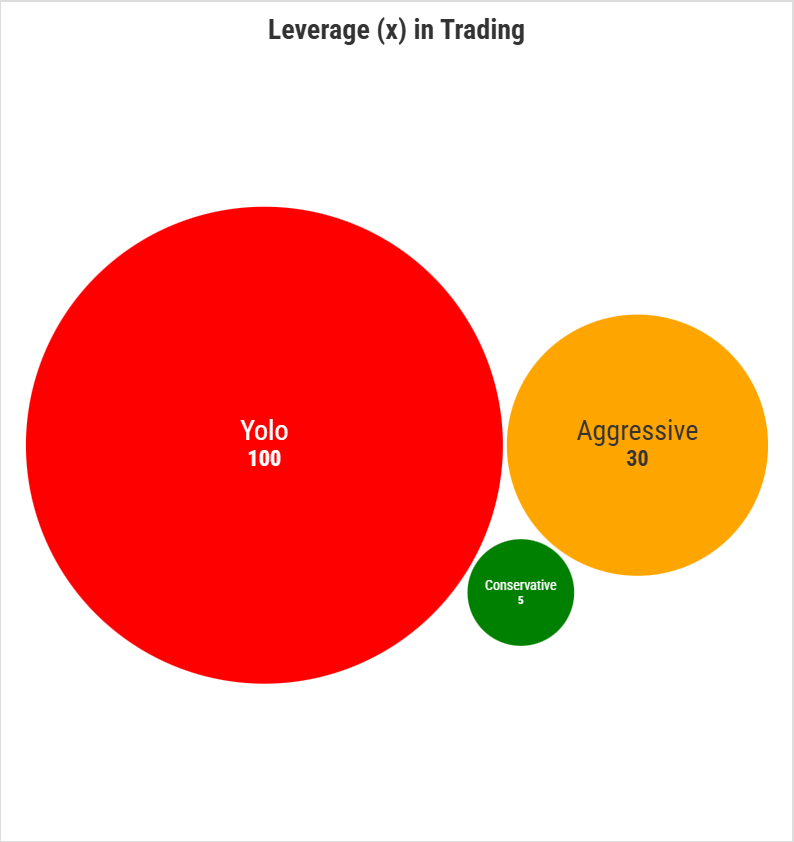
Example 1: Conservative approach
A trader has $10,000 in their account, chooses 5 leverage. They open a $50,000 position in GBP/USD. If the market moves 1% in their favour, it’s a $500 gain, a 5% return. If the market moves 1% against them, that’s a $500 loss. Manageable, but significant.
Example 2: Aggressive approach
Same trader, but now using available 1:30 leverage and opens a $300,000 position. A 1% move means $3,000 gained or lost, a 30% swing versus the account size. Just three consecutive 1% drops could wipe out nearly all funds, triggering a margin call.
Example 3: All-in Yolo approach
Going ‘all in’ at 1:100 leverage, controlling a $1,000,000 position with $10,000. A move of just 1% against the trader loses $10,000, erasing the entire account in moments. This is high-risk gambling, not trading.
How to use leverage responsibly
Common mistakes when trading with leverage
The following practices keep traders safe:
- Use stop-loss: Define a maximum loss before entering any trade.
- Position sizing: Never risk too much, use the ‘1% rule’ and base trade sizes on account equity.
- Monitor margin level: Keep regular tabs on the free margin and balance. Never let effective leverage creep higher unnoticed.
- Avoid emotional trading: High leverage can foster impulsive decisions. Plan trades in advance and stick to the strategy.
- Diversify: Spread risk among several positions instead of ‘betting the farm’ on one trade.
Best practice with ultra-high leverage
- Never use maximum leverage: Start with smaller ratios (e.g. 1:100) and scale only as experience and results justify. Leave plenty of margin buffer, avoid ‘all in’ trades.
- Risk management: Implement strict stop-losses on every trade. Calculate risk per trade using the ‘1% rule’.
- Stay informed and disciplined: Monitor news, volatility, and economic releases closely.
- Have trading plan: Stick to it as emotional reactions invite outsized losses.
- Choose reliable brokers: Favour regulated brokers when possible. For offshore choices, check for segregated accounts, negative balance protection and responsive support.
Conclusion
Leverage is a powerful tool in trading, but traders must strike a balance. The question isn’t ‘how much leverage can I get?’ but rather ‘how much leverage should I use given my experience and risk tolerance?’
Most new traders should use only a fraction of what’s offered. Understanding effective versus absolute leverage is central to strategy as well as long-term success. Instead of falling for the appeal of maximum leverage traders need to have proper risk management to keep their account growing.
Frequently asked questions
How does leverage affect my profits and losses?
Leverage amplifies both profits and losses. A $1,000 account trading at 1:100 leverage can gain $1,000 (100%) from a 1% market move, but can also lose the entire capital.
What are margin requirements?
Margin is the collateral needed to open and maintain a leveraged position. If margin requirements are 1%, then a $100,000 trade will need a $1,000 deposit in margin. Lower margin requirements allow higher leverage, but increase risk.
Can I lose more money than I invest when trading with leverage?
Yes, losses on leveraged trades are calculated on the full position size, not just the initial margin. If the market moves against a trade, you may owe more than your deposit unless your broker offers negative balance protection.
What is a margin call?
A margin call happens when the account equity drops below the maintenance margin level. The broker may close some or all trades automatically to prevent further losses if the trader fails to add funds.
Is leverage risky?
Leverage is inherently risky due to the potential for rapid and big losses. Novice traders are advised to start with low leverage until they have acquired risk management skills.
Can I change my leverage level?
Most brokers allow clients to adjust leverage on request, but lowering leverage will increase margin requirements for new trades.
Can I trade forex without leverage?
Yes, some brokers offer 1:1 leverage. This limits profit potential but also reduces risk, which can be suitable for beginners or those with large funds.