

Most traders think that STP forex brokers are safer and market makers (MMs) are to avoid. Historically, it was rather true as MMs had a tarnished reputation, often called ‘bucket shops’ with predatory dealing.
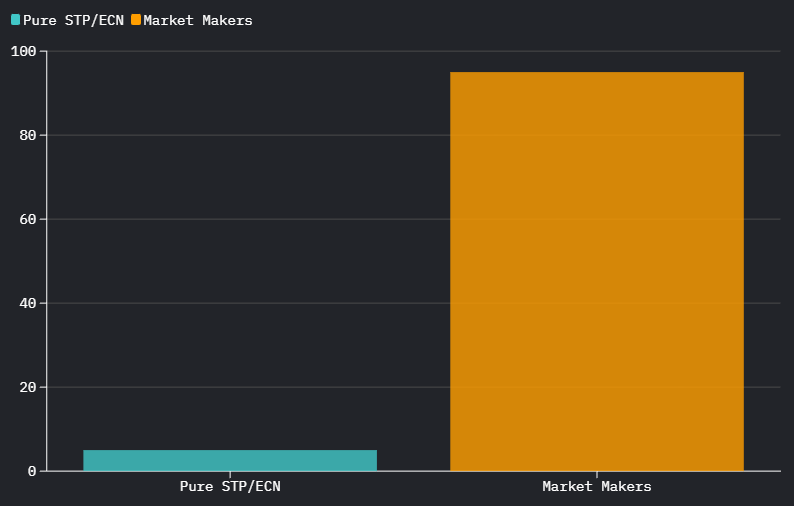
To spice things up, this negative connotation has led many brokers to advertise themselves as STP or ECN, yet the reality is that 95% of all forex and CFD brokers operate a market maker (B-book) model.
This article aims to cut through common misconceptions. The goal is not to defend one model over the other but to uncover the real trade-offs with following points:
- Real reasons to avoid market makers (or B-books)
- Disadvantages of trading with STP (or A-books)
- Pros and cons of trading with market makers
- Traders most suitable to use them
Why STP is not always better
The STP/ECN model, often called A-book, or no dealing desk (NDD) is seen as the ‘gold standard’ of trading execution. That is the theory, but in practice, this model has its own drawbacks for brokers and traders.
Do traders have direct market access
Most don’t. Many traders believe A-book means direct interbank access but the hard fact is that true STP doesn’t cater for retail folks. STP is mostly a marketing stunt like a glossy Big Mac picture. Market access is reserved for institutions dealing in large ticket sizes, often above the thresholds retail brokers aggregate.
Instead, retail orders are sent to intermediaries such as multiple liquidity providers (LPs), prime of prime (PoP) or prime brokers where they are internalised. What appears as a ‘straight-through’ connection often goes to a bigger player who will gladly take the opposite side.
That is when the orders actually get sent somewhere. Quite often, brokers will digest the trades via their B-book, basically trading against clients. This is especially true for small positions under 5 lots.
What are drawbacks of trading with STP brokers
Order routing creates technical and execution-related challenges for traders looking for fast and 100% fills. Here are common problems when dealing with real STP.
- Execution delay. Each trade must go from the trader’s terminal to the broker’s server, then through a liquidity bridge to an LP, and finally back again with confirmation. This round-trip introduces milliseconds of delay that can impact accuracy.
- Wider spreads: A-books rely on external liquidity and in case of high volatility events or thin liquidity, traders may experience wide spreads as brokers have zero control over pricing and execution.
- Slippage: Brokers often promote raw spreads and low commissions but trading with STP comes at a hidden and major cost called slippage. Because orders are sent outside and the price shown may change by the time it hits the market. Another reason is thin liquidity at the top of the book, making orders filled at gradually worse prices. That is why ‘raw’ spreads shown on a demo rarely reflect live trading conditions.
- Rejection and requote: LPs may reject an order if the price is no longer available or if the order size exceeds the market depth. The broker may send back a requote or simply reject the order, forcing the trader to re-enter at a different price.
- Partial fills: A-book brokers pass trades to multiple liquidity pools and orders might be broken up across providers, resulting in uneven filling and varying price levels. Moreover, if there is not enough depth for the price, only a portion of the order will be filled.
- Higher cost: As STP brokers earn through commission mark-ups rather than client losses, they cannot compete with B-books by lowering their fees, making trading more expensive.
In summary, while STP provides more transparent access, traders must accept the trade-off of inconsistent execution which is the cost of participating in the real market. In contrast, the market maker or B-book model offers fast fills, stable pricing and predictable execution.
Why do market makers have bad reputation
The problem lies not in the execution model but in how the broker manages conflicts of interest. Historically, many have profited unscrupulously from client losses. There have been tons of clients who saw quotes manipulated, stops unfairly triggered or profits erased. These ‘bucket shops’ operated with little oversight, cementing the public perception of market makers as dishonest.
In recent years, that image has improved somehow by regulatory interventions. Authorities like the FCA, ASIC and ESMA now require transparency in execution, best price delivery and protection of client funds through measures such as segregated accounts and investor compensation schemes.
Brokers are audited regularly and risk heavy penalties for malpractice. However, many have chosen to handle trades via their offshore entities. This is for two key reasons:
- To reduce operation complexities and costs associated with tight regulations.
- To give what most retail traders want, such as higher leverage and deposit bonus, things their original onshore entities can no longer offer.
Today the debate has shifted from ‘STP vs. market maker’ to ‘onshore vs. offshore’. Traders should always consider the risks from this regulatory loophole. Yet the stigma remains. Many traders instinctively assume ‘market maker equals scam’.
How modern market makers operate
Given the reputation, most brokers avoid mentioning ‘market making’ or ‘B-book’, which are basically two sides of the same coin, and emphasise on their STP or ‘A-book’ aspect, even if it is only one part of their model, if any.
Are there pure STP brokers
Yes, but not for retail traders with average deposits under $10,000. Most people will be dealing with market makers which bear little resemblance to their early counterparts. Rather than lumping all traders into one book, they now use automated profiling to distinguish between long-term profitable clients who are A-booked and short-term or low-volume traders who are B-booked.
Ironically, for those who avoid brokers which trade against them, someone down the line has to take the opposite side, be it liquidity provider or bank. In that sense, every participant in the forex market acts as a market maker. The idea of a ‘pure STP’ broker is more myth than reality and this is why forex is a zero-sum game where someone’s loss is always another one’s gain.
When do brokers use A or B-book
The evolution of brokerage has moved towards hybridisation. Today’s most respected firms seamlessly switch between A and B-book based on volume, market risk and client profile. AI-driven risk systems monitor volatility, client behaviour and positions. If exposure goes past set thresholds, trades are hedged externally, ensuring the broker keeps risk under control.
Yet importantly, it’s client profiles that make brokers choose which model to use. Yes, that is the hard truth of retail brokerage. After all, if 80% of them lose, why would a broker let anyone else get the lion share of the pie?
An common industry practice is to B-book accounts with deposits under $5,000 as these small retail guys are likely to lose their shirts. This is especially true for small to medium-sized brokers. For big firms with sophisticated systems and dynamic hedging, the A/B switching is based on a combination of client and trade analytics and market risks. This also means that if a trader is consistently profitable, the broker is likely to pass their trades into the market.
Thus, the line between STP and market making is blurring. The relevant question traders should ask is not “Is my broker STP or market maker (A- or B-book)?” but rather “Is my broker regulated and fair?” In practice, the label “market maker” simply describes how risk is handled, internally or externally, not necessarily how ethically a broker does business.
Here’s an important note: one of the most obvious ways to see whether a forex broker is a market maker is by checking its maximum leverage as liquidity providers rarely accept orders above 1:100 leverage. For more information, these are the reasons why some brokers offer extremely high leverage to retail clients.
Pros and cons of trading with market makers
Market makers undeniably offer benefits when it comes to the quality of trade execution.
Advantages:
- Reduced slippage: Clients can trade in larger sizes, for example 10 lots of gold with little slippage.
- Better liquidity: Internalised liquidity ensures clients can still trade during volatile times.
- Lower trading costs: Without LP fees, spreads can be tighter and commissions minimal, ideal for clients who trade small sizes or scalp.
- Faster execution: No routing latency means that orders are filled almost instantly.
- Better fills: Execution is smoother with fewer rejections and re-quotes, even in case of high volatility.
- Accessibility: Brokers allow smaller deposits and offer flexible leverage terms, ideal for entry-level traders.
- Promotions and rewards: Many offer bonuses or rebates, which are rare among pure STPs.
Drawbacks:
- Conflict of interest: Brokers profit when clients lose, while regulation and hedging policies can mitigate this, some offshore brokers can only tolerate consistent winners up to a certain amount.
- Trade manipulation: In less regulated jurisdictions, unscrupulous brokers might still alter quotes or trigger stop-losses artificially.
- Reduced transparency: Brokers may obscure their dealing-desk status, which can mislead clients about execution conditions.
- Not for large accounts: Some market makers may choose not to deal with large professional or institutional clients.
| Trading experience | STP (A-book) | Market maker (B-book) |
|---|---|---|
| Spreads | Higher | Lower and stable |
| Liquidity | Event-dependent | More stable |
| Slippage | More often | Less often |
| Execution speed | Fast | Ultra fast or instant |
| Rejection & re-quote | Sometimes | Minimum |
| Accessibility | High deposit | Low deposit |
Traders are advised to review brokers’ execution policies, check for disclosure of dealing-desk operations (see FAQ below). A regulated market maker often offers the best balance between performance and protection.
When to trade with market makers
While some traders swear by direct market access, others may find market makers perfectly suited to their needs. The decision depends largely on trading style and capital size rather than the model itself.
New or small-cap traders: Except a few STPs with no market making licence in highly regulated jurisdictions, traders have few choices honestly. But that’s not the end of the world. They may actually offer an approachable entry point with lower minimum deposits and smoother trading conditions.
Scalpers and intraday traders: Their strategies rely on speed and low spreads which are conditions internalised systems naturally offer. Brokers with solid tech infrastructure and execution models can give retail traders an edge. Besides, LPs often consider these ‘toxic flows’ and can either reject or increase their spreads.
Traders focusing on major currency pairs: market makers have no problem internalising EUR/USD, GBP/USD and USD/JPY because liquidity remains abundant. They can hedge internally with their large client pool, de facto removing the conflict of interest.
News traders: During volatility spikes such as non-farm payrolls or central bank decisions, B-book brokers can sustain fills even when external liquidity providers reject or widen spreads. As a result, they offer reliability at times when entry and exit matter most.
In contrast, traders churning large positions or institutional strategies should look elsewhere. Similarly, professionals who demand complete market visibility may find B-book setups limiting.
A regulated dealing desk using advanced analytics and adhering to can easily outperform an unregulated “STP” broker in both service and safety.
Conclusion
The STP vs. market maker (A-book vs. B-book) debate has long fuelled misunderstanding within the trading community, as many still see market makers with manipulation or deception. Amid brokers’ marketing jargons, understanding that true STP is mostly out of reach is the first step to see what the forex industry has to offer.
Today, thanks to regulatory impact and technology, the “right” broker is not about execution models but fair-dealing standards. For the majority of traders, a market maker with a solid reputation may provide better pricing and faster execution.
Frequently asked questions
How to know if my broker is a market maker?
There are several clues. First check their regulator’s page and see if they are authorised as a market maker. Second, go through their offerings and anything such as small deposit, bonus or ultra-high leverage are signs that they do market making.
What does No Dealing Desk (NDD) mean?
It’s a marketing fad, and this is from people who have worked at liquidity providers. All brokers, STP or market makers have a dealing desk (DD) to handle operations such as trade parameters, commissions/swaps and risk management. Even STPs need it to deal with LP relations and markups. The real concern traders should have is whether the DD will manipulate their trades, which brokers who are regulated and care about reputation won’t. This is why NDD or STP should not be a primary criteria when choosing a broker.
Will my trades go to the market?
The answer is ‘no’ if you have a small account (under $10,000 for larger brokers) and most importantly, if you are not consistently profitable. The broker will internalise your trades, not that different from giving up to LPs from your perspective.
Can a broker be both STP and market maker at the same time?
Yes, most modern brokers use hybrid models, dynamically routing certain order flows internally (B-book) and others to the market (A-book), depending on client profile and market conditions.
Is it true that market makers want clients to lose?
Only shady ones do. Decent brokers use risk management and focus on long-term business sustainability rather than exploiting client losses.
Are market makers riskier or less reputable?
The risks aren’t from their B-book model but from lack of regulation and transparency. Well-regulated market makers must meet compliance standards and fairness requirements. Choosing an FCA, ASIC or CySEC licensed broker significantly reduces risk.
Do STP brokers guarantee better prices or execution?
Not always. While STP offers more direct market pricing, execution can be subject to liquidity issues, slippage and order rejections in volatile markets. For small trades, market makers usually offer more reliable execution.